

:format(webp))

:format(webp))

:format(webp))


What is a point of sale?
A point of sale is the moment and place where a customer pays you for goods or services. In a shop, it is the counter. At a market, it’s your stall. Online, it is the checkout page. The term also covers the technology you use to record and complete that sale.

:format(webp))
Nakita Bam
Sep 18, 2026
7 mins
:format(webp))
:format(webp))
Learn
What does "point of sale" mean?

:format(webp))
A point of sale is the moment a sale between you and a customer is completed. Money changes hands, and ownership of the goods or services transfers.
In everyday use, the term covers the place where it happens : the counter, the pay point, the till, the checkout area. A coffee shop counter is a point of sale. A food truck window is a point of sale. An online store's payment page is a point of sale.
The point of sale exists whether or not technology is involved. A cash sale at an informal market has a point of sale. What technology changes is how accurately that sale gets recorded and what you can find out from it afterwards.
What does POS stand for?
POS stands for point of sale.
The abbreviation is used across the payments and retail industry for both the moment of sale and the systems used to manage it. "POS system" and "point of sale system" mean the same thing.
Many South African businesses call the point of sale "the till" or "the counter," even when their setup includes software and a card machine working together.

Key point of sale terms
The terms below appear throughout this guide and across the Knowledge Hub.
Plain-English meaning |
|---|
Point of sale The place and moment a purchase is completed. |
POS system The full setup used to process and record sales. |
POS software The programme that manages checkout and sales information. |
POS hardware The physical equipment used at checkout. |
POS terminal The device on which a sale is entered or completed. |
Payment terminal A device primarily used to accept card or digital payments. |
Card machine A common name for a device that accepts card payments. |
Checkout The process through which the purchase is completed. |
Term | Plain-English meaning |
|---|---|
Point of sale | The place and moment a purchase is completed. |
POS system | The full setup used to process and record sales. |
POS software | The programme that manages checkout and sales information. |
POS hardware | The physical equipment used at checkout. |
POS terminal | The device on which a sale is entered or completed. |
Payment terminal | A device primarily used to accept card or digital payments. |
Card machine | A common name for a device that accepts card payments. |
Checkout | The process through which the purchase is completed. |
The difference between a point of sale and a POS system
A point of sale is the moment and place a sale happens, and a POS system is the hardware and software you use to process and record it. The difference changes what you’re buying or setting up.
Point of sale | POS system |
|---|---|
What it is The moment and place where a customer pays. | What it is The hardware and software used to process and record that transaction. |
Exists without technology Yes. A cash sale at a market stall has a point of sale. | Exists without technology No. A POS system is technology by definition. |
What it includes The transaction event itself. | What it includes Devices, software, payment processing, and often reporting and stock management. |
Point of sale | POS system | |
|---|---|---|
What it is | The moment and place where a customer pays. | The hardware and software used to process and record that transaction. |
Exists without technology | Yes. A cash sale at a market stall has a point of sale. | No. A POS system is technology by definition. |
What it includes | The transaction event itself. | Devices, software, payment processing, and often reporting and stock management. |
A point of sale is something every business already has by virtue of it being able to make a sale. A POS system is the technology that makes that sale faster, more accurate, and easier to track.
For a full explanation of what a POS system includes and how it works, read What is a point of sale system?
What happens at the point of sale?

:format(webp))
Every sale runs through the same five steps. That holds whether you handle the steps by hand or a system handles them for you.
The customer decides to buy.
The business identifies the item and its price.
The customer pays (by card, cash, or another method).
The sale is recorded.
The customer receives proof of purchase.
In a manual setup, you price the item from memory, take the payment, and write the sale in a notebook. When a POS system is involved, steps 2 to 5 happen automatically. The system looks up the price, processes the payment, deducts the item from stock, and generates a receipt.
The more you automate, the more accurate your records are and the less you do by hand at the end of each day.
What a system does automatically can vary by provider and by plan.
Why point of sale matters to small businesses
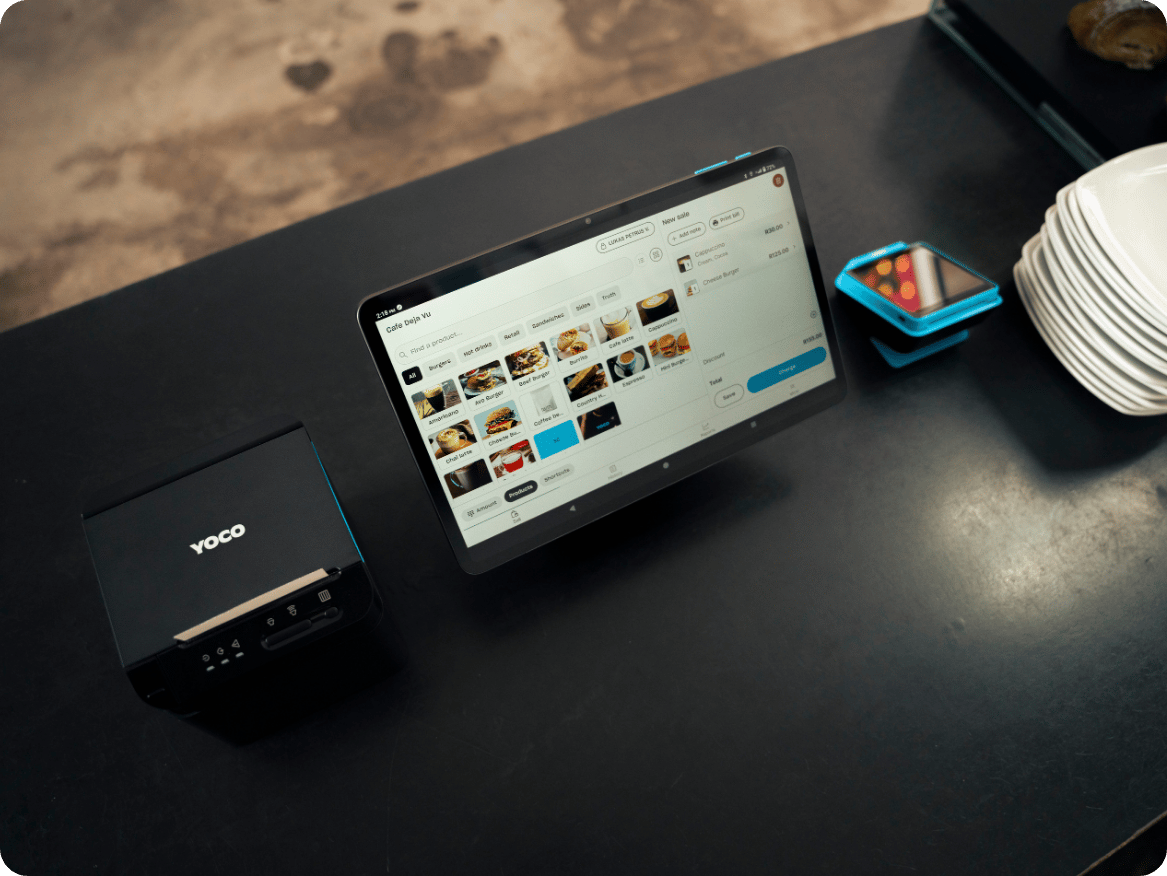
The point of sale is where your sales data comes from. Every sale that passes through it creates a record, and when those records are accurate and complete, you can answer questions without manual counting or guessing:
What sold today, and how much did you take?
How much stock is left?
Which payment method do your customers use most?
What does your busiest trading hour look like?
Without a structured point of sale setup, answering any of these requires a separate spreadsheet or end-of-day estimate. A POS system answers them automatically, from the same data you generate with every sale.
When you shift your point of sale from furniture to your business operations core, you stop just taking money. You gain real-time visibility into what’s happening in your business - no extra admin required.

:format(webp))
What point of sale means in South Africa
In South Africa, four local conditions decide which point of sale setup is appropriate and reliable for your business.
Load shedding affects every business using electronic equipment. Point of sale devices with a built-in battery and mobile connectivity, meaning SIM and Wi-Fi, rather than Wi-Fi only) can keep taking payments through an outage. Whether a device depends on a powered router or can operate on a mobile network is a practical buying consideration that does not apply in most other markets.
Connectivity is inconsistent outside the major metros. A cloud-based POS system that needs an internet connection to work may fail in these conditions. Some devices offer offline transaction capability, storing sales locally and syncing when connectivity returns. A card payment needs a connection via SIM or Wifi either way, so a device with its own mobile data keeps you taking payments and making sales on your POS system.
Under the Consumer Protection Act (No. 68 of 2008), your business has to give proof of purchase when a customer asks for it. A POS system does this for you with a printed or digital receipt.
Cash is still widely used, particularly in townships and informal markets. A point of sale setup that records only card transactions misses all your cash sales. Most POS systems in South Africa handle both, so the reporting covers every sale.
On card payments, the transaction fee comes out of what you receive. Your customer pays your price, but you get your price minus the transaction fee from your payment provider.
Across banks and other providers in South Africa, a blended rate typically ranges from 1.6% to 2.85% of the value of the sale, on a mix of 60% debit and 40% credit. It varies between payment providers, POS systems and the plan you sign up for.
A low device price can still cost you more to run, because the software fee and the transaction rate are part of what the setup costs you.
:format(webp))
:format(webp))
:format(webp))
:format(webp))
:format(webp))