Small-Town RSA: Where South Africans spend over the festive season
In part 2 of our Seasonal Spend Report, we look at the impact of local tourism on the South African independent business economy.
05 Feb 2026
Yoco Editor
This is part 2 of our Seasonal Spend Report, where we unpack the numbers from the 2025 festive season and what impact this has had on the South African independent business economy.
Some South African towns see their local economies transform almost overnight in December. In fact, five towns recorded increases of more than 200% in average spending between November and December in 2025. These are not marginal gains. They represent a fundamental shift in local economic activity over a very short period of time, during the most important trading month of the year.
Using Yoco transaction data from more than 200,000 South African merchants, we’ve analysed how festive spending shifts between November and December, where that spending resurfaces, and which areas benefit the most from this movement.
The festive season redistributes spending from inland to the coast
The festive season does not simply create more spending. Its biggest impact is where that spending takes place. As South Africans travel locally, money moves out of major economic hubs like Gauteng, and into smaller towns across the country. From mid- to late November, transaction volumes in Gauteng begin to taper off, while spending accelerates in other provinces.
This shift matters. Domestic tourism underpins the festive economy, with locals accounting for around 87% of all festive-season spend, compared to just 13% from international visitors. While international tourism often draws more attention, it is local movement that sustains economic activity at scale.
For small businesses, especially in coastal and holiday towns, this redistribution delivers a vital cash injection over a short period of time. In many cases, December trading is not just a seasonal boost, but a financial lifeline that helps carry businesses into the new year and beyond.
Let’s get into the numbers.
Coastal provinces are the biggest winners
The coastal provinces, along with Limpopo, are the biggest beneficiaries of redistributed spending across the country, with the Eastern Cape seeing the largest uplift.
Transaction values in this province increased by 46% between November and December. This is followed by Limpopo at 32%, and KwaZulu-Natal’s 29% increase.
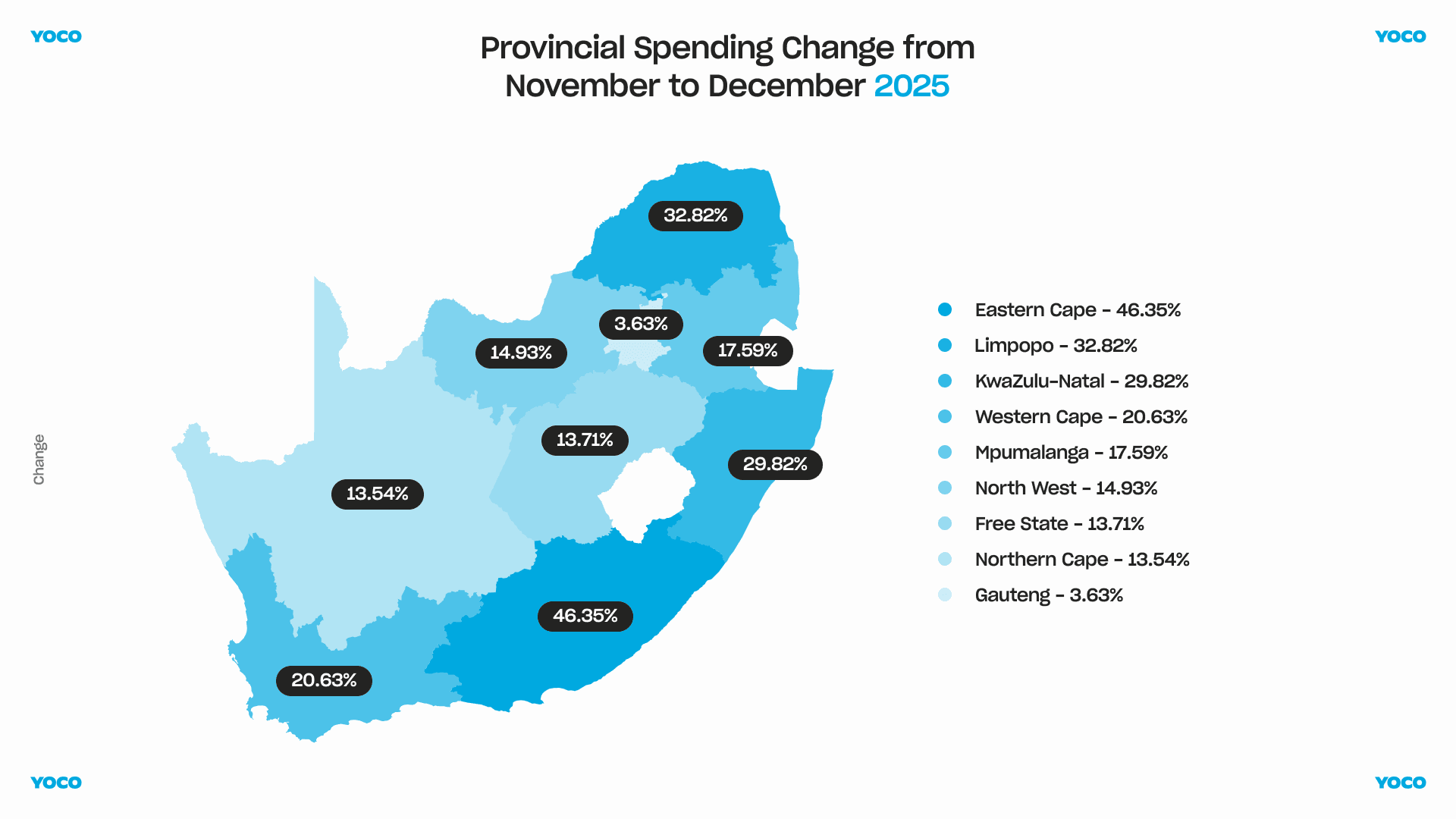
In the Western Cape, the festive season and domestic travellers add a meaningful boost to the province, but it is not the dominant driver of spending in the same way it is for more seasonal provinces. It sees a smaller increase of about 20% over this same period, largely because the province already starts from a much higher spending base in November.
Increases in coastal provinces are driven by tourist spending patterns
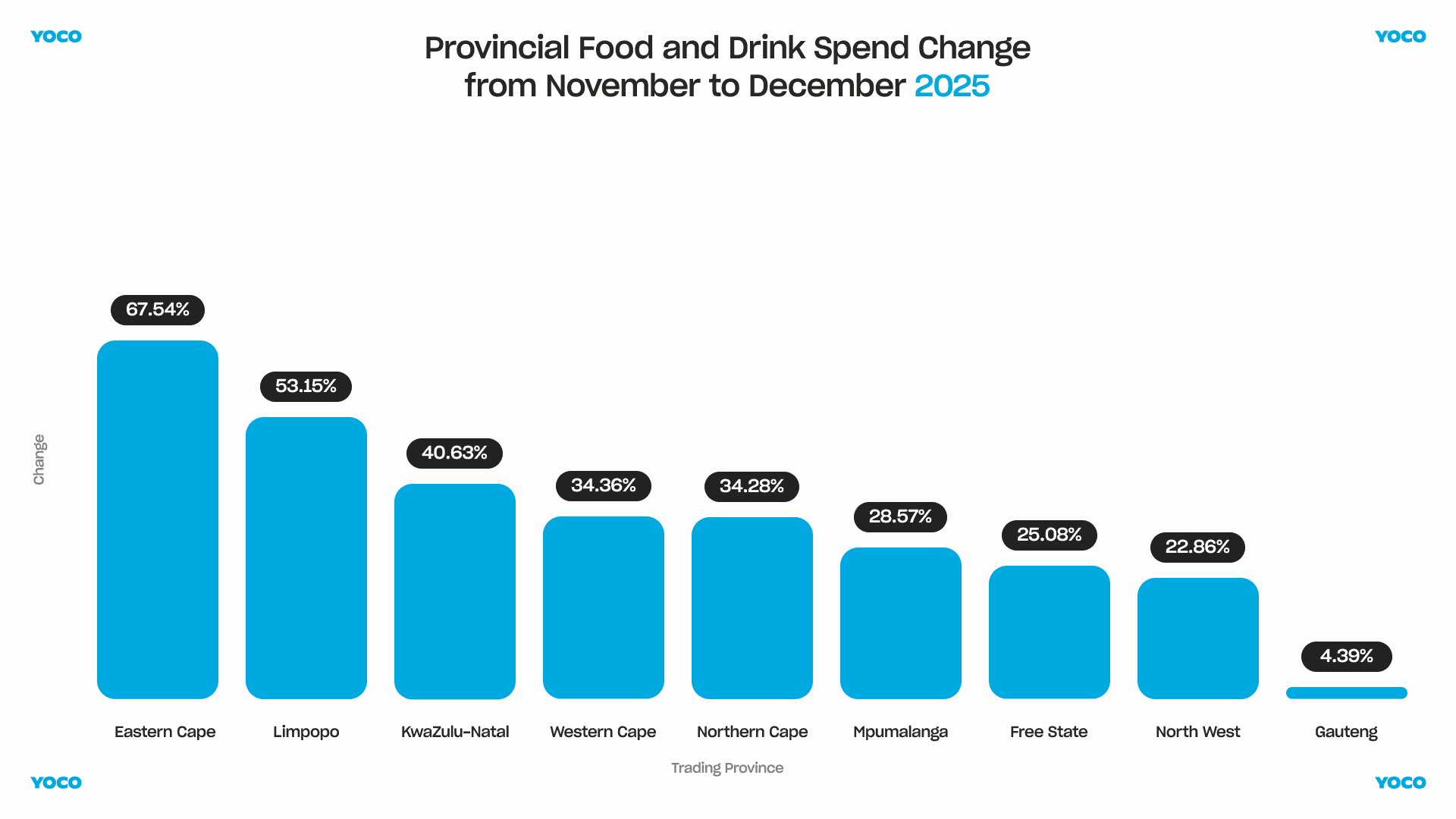
The festive uplift is not driven by everyday spending patterns, but by holiday-specific behaviour — particularly eating out. Food and drink merchants saw the biggest increase in transactions in each of the provinces with the largest increases from November to December.
Again, the Eastern Cape saw the biggest jump in food and drink spend which rose by roughly 68%. This was followed by Limpopo and KwaZulu-Natal with a 53% and 40% bump, respectively.
Again, the Western Cape sees more moderate growth (around 34%), reflecting its higher baseline.
Small towns see the biggest festive season fluctuations
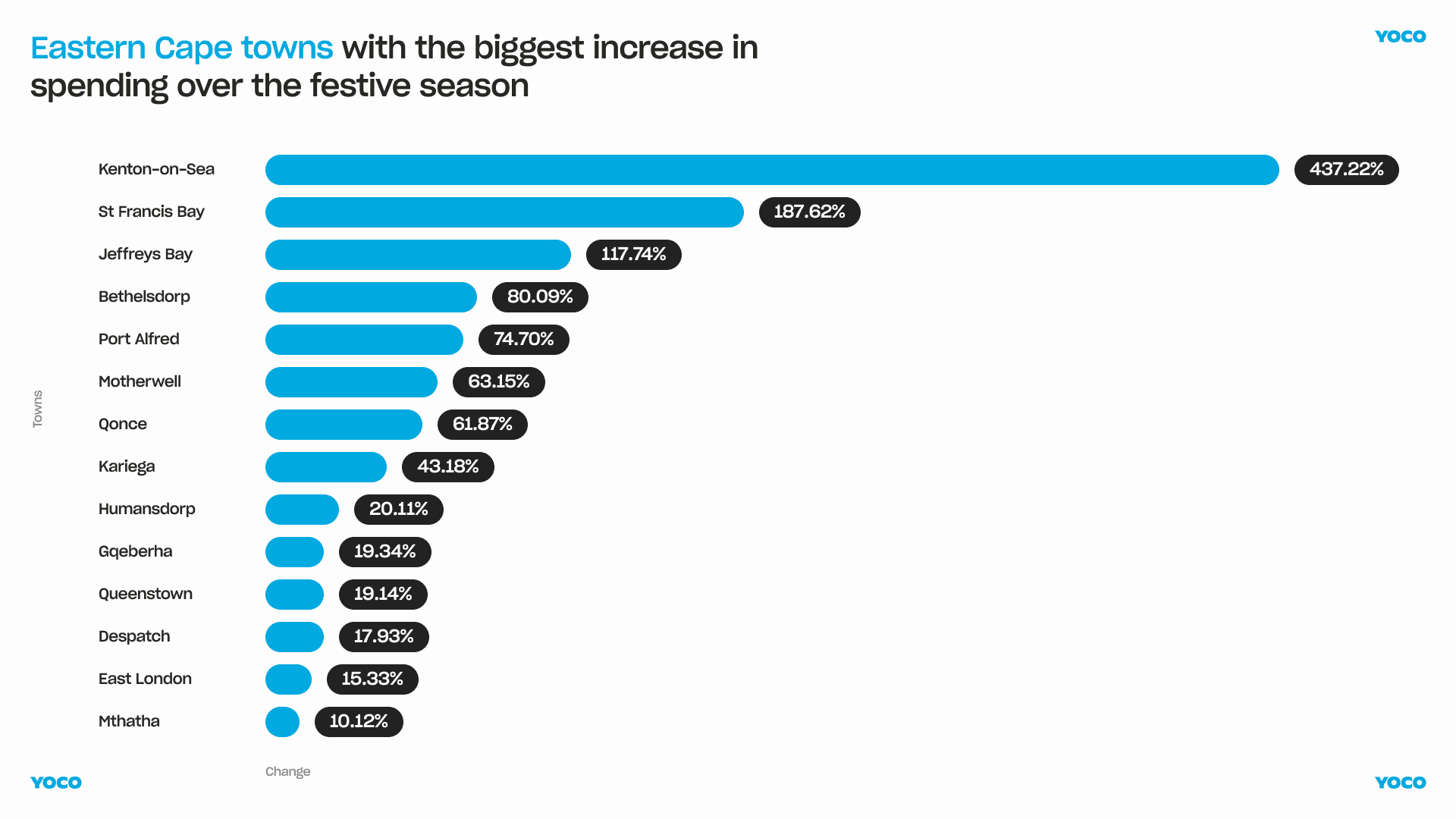
While provincial trends are important, the most dramatic festive effects appear at a town level, particularly in small coastal destinations. The towns with the largest November-to-December increases are concentrated almost entirely in the Eastern Cape and Western Cape.
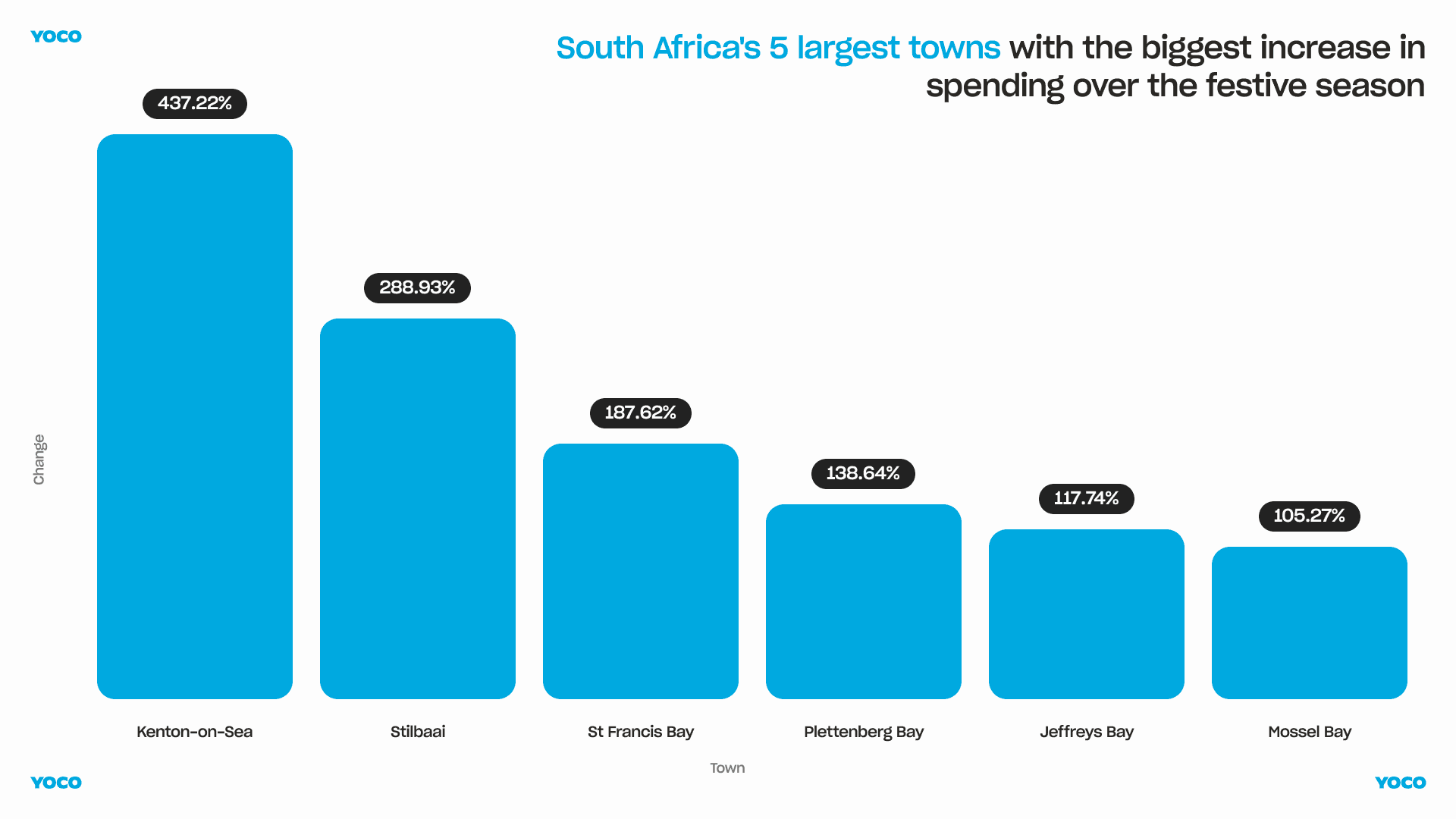
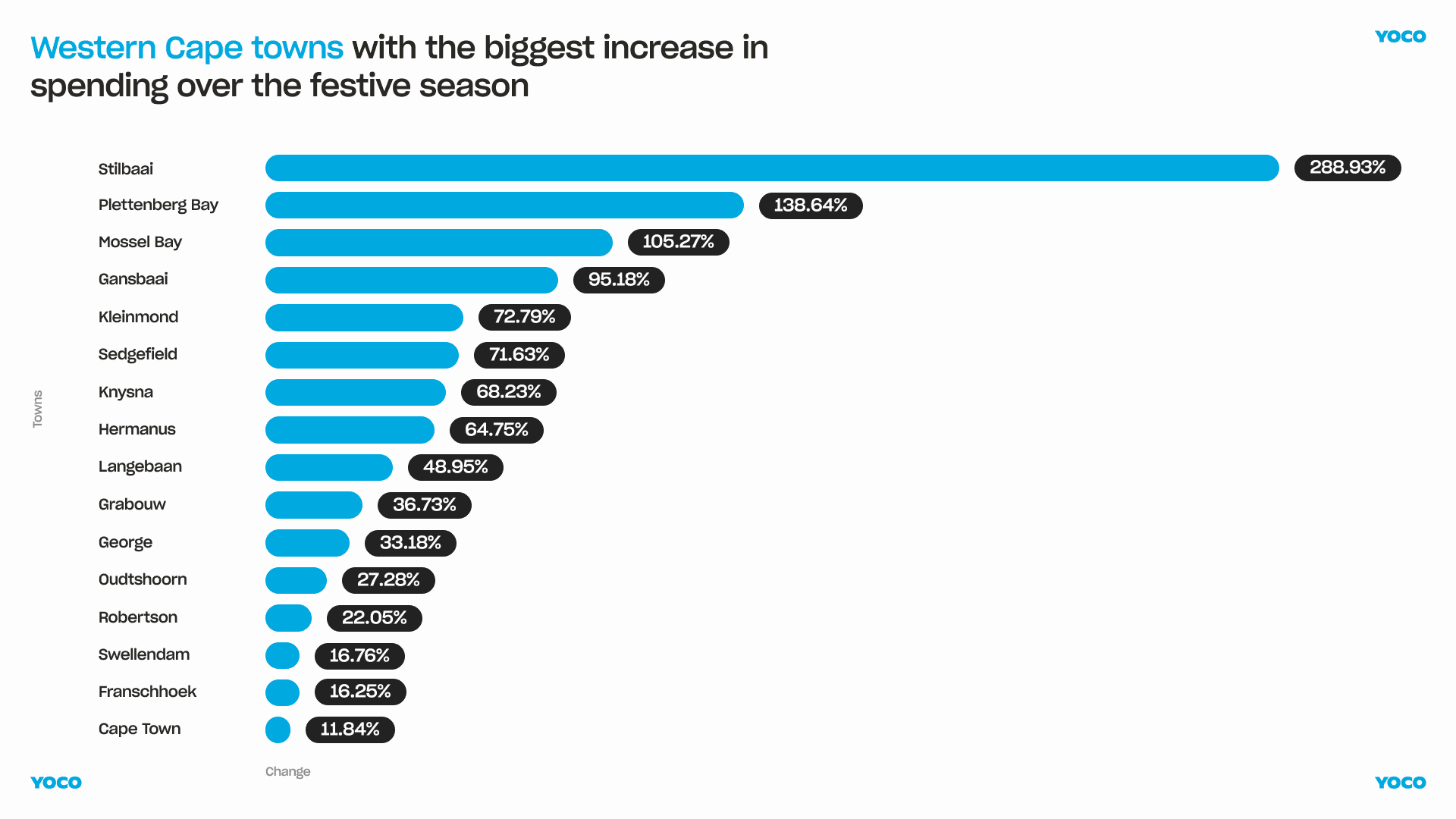
Kenton-on-Sea saw the country’s biggest overall increase with merchants processing transactions worth 437% more than they did in November. Stilbaai led the Western Cape with a 289% increase.
It’s not just the small towns (and even larger ones such as Jeffrey’s Bay) benefiting from these fluctuations. Larger cities in the Eastern Cape, including East London and Gqeberha, also recorded solid double-digit increases.
The country’s major metros all saw an increase in year-on-year spending, with Cape Town seeing the biggest increase at 8%. The biggest increases, however, were seen outside of Cape Town. Small towns in the province received a much larger relative increase in spending during the festive season. Stilbaai led the province with a 288% increase, followed by Plettenberg Bay (+138%), and Mossel Bay (+105%), who both saw spending more than double from November to December.
KwaZulu-Natal’s North and South Coast are the province's biggest draw
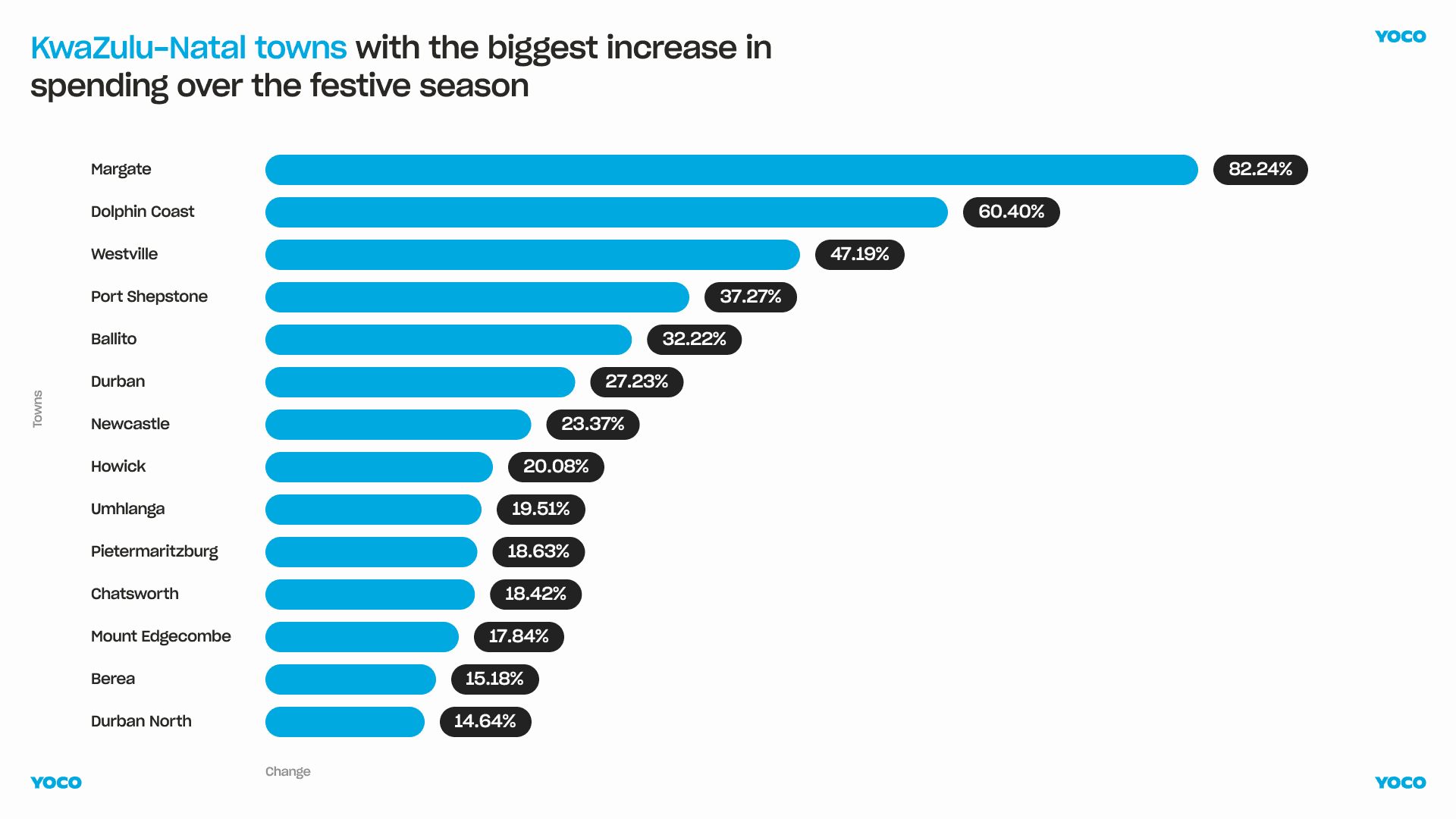
On KZN’s South Coast, Margate saw the province’s biggest spending increase at 82%. Another South Coast town, Port Shepstone, had the fourth biggest increase with 37%
Among towns on the North Coast, the Dolphin Coast and Ballito gained the most from people spending their holidays in the province. Spending here rose by 60% and 32%, respectively.
It’s not just small towns in KZN benefitting. Durban and its surrounding suburbs saw a healthy festive season too. In the city itself, merchants saw a 27% increase in transactions – the highest among the country’s major cities. Two of its suburbs, Westville and Durban North also saw a major rise in transactions at 47% and 14.6%, respectively.
Home for the holidays
Festive season spending isn’t only about travel. Homecomings matter too. In Gauteng, where many people leave the province over December, spending declines in several major areas. Centurion, for example, sees a 10% drop between November and December, while Midrand and Germiston fall by 5.4% and 5%, respectively. Johannesburg sees only a small single-digit change.
Soweto, however, remains a notable exception with a 35% growth rate, the only area in Gauteng to see double digits. This points to a "celebration at home" effect, where the festive season is defined by family reunions and local tradition. Instead of travel-related costs, spending is redirected into the local ecosystem as residents and returning family members prioritise celebrating within their own community.
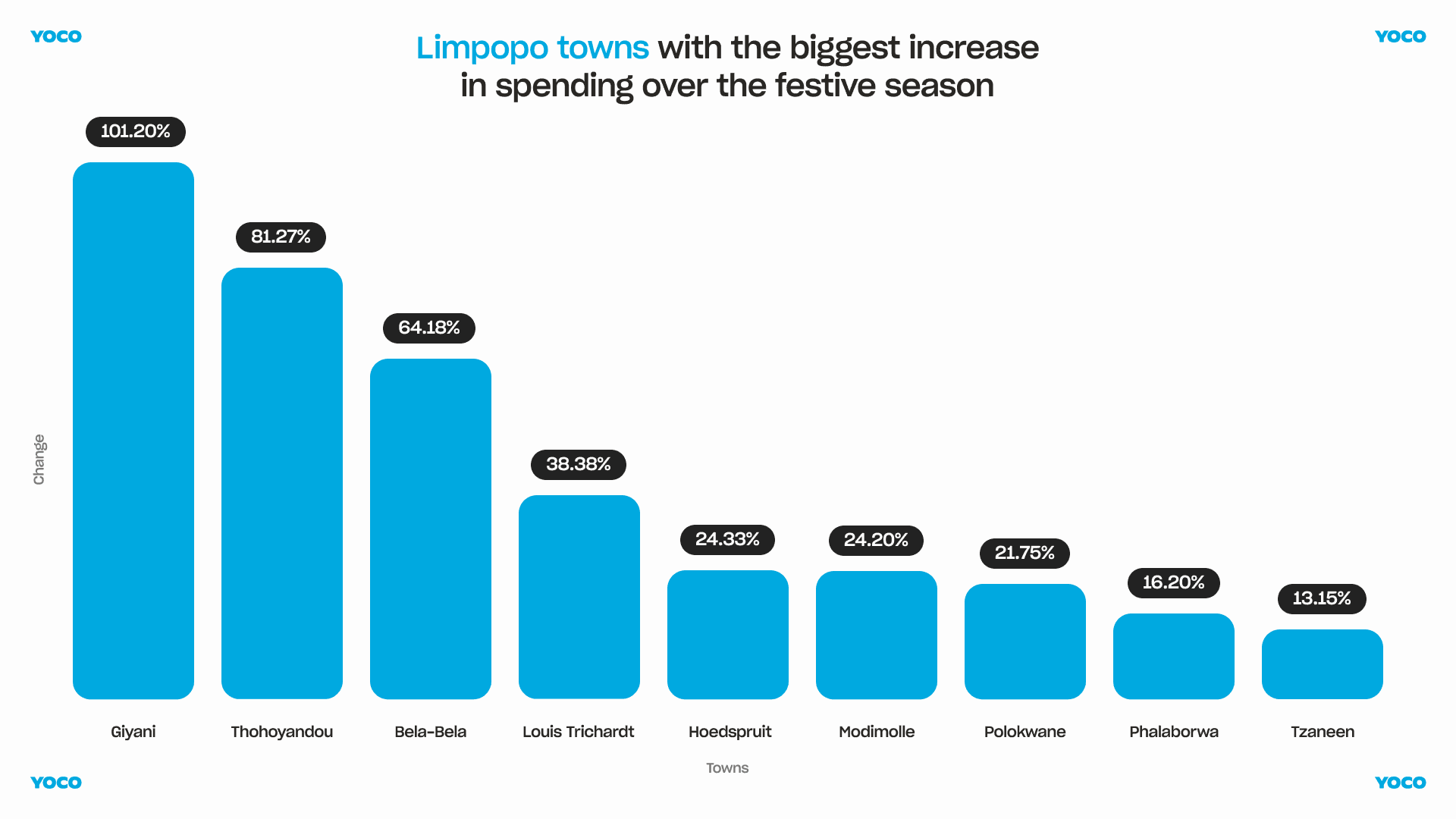
A similar pattern appears in Limpopo. While the province boasts some of the country's most popular tourist destinations, the strongest growth in spending is visible in towns that aren’t traditional holiday hotspots, such as Giyani and Thohoyandou.
This suggests that festive travel is as much about returning home to visit family as it is about leisure. In KwaZulu-Natal, areas like Pietermaritzburg and Chatsworth also benefit from this kind of home-based increase in spending.
How merchants can make the most of this
The festive season reshapes South Africa’s economy not by creating spending, but by moving it. Understanding where that money goes, and why, helps to define why the country’s small towns feel December so intensely, and why domestic travel remains one of the most powerful forces in the country’s local economy.
Here’s how you can plan for this season based on where your business is located.
For merchants in Gauteng
Bring the festive feeling forward
Customers switch into “end-of-year mode” earlier than December. Introducing festive bundles or small treats in November allows you to meet them where they are.Plan for a quieter back half of December
Many regulars head off on December break, so it may be wise to ease back on costs, stock, and staffing toward the end of the month.Make it easy for customers to spend a little extra
Thoughtful add-ons or upgrades can lift sales without requiring more foot traffic.Appeal to the stay-cationers
Not everyone travels. Messaging that focuses on comfort, convenience, or small indulgences at home often resonates with locals.Think about how you’ll welcome people back
A simple “welcome back” offer in January can help kickstart momentum once customers return to their homes.
For merchants in coastal and highly seasonal towns
Treat December as a special version of your business
For many coastal towns, December is its own season. Simplifying menus, ranges, or services can make busy days feel more manageable.Plan ahead for a smooth December
Finalising prices, menus, and staffing ahead of time gives you the time and freedom to focus on what really matters when the busy season hits.Show up and be present
When things get hectic, having owners or managers visible on the floor can make a real difference to both staff and customers.Make the most of the new faces you see
December brings in people who may not return for months. A gentle prompt to follow your business or sign up for updates can help you stay connected and create a new following.Be kind to your January self
If December goes well, setting capital aside can make the quieter months ahead feel far less stressful.
For merchants in small inland and non-tourism towns
Plan for people coming home, not passing through
Festive spending often comes from family visits and reunions, so offerings that work for groups tend to do well.Stick to what people already love about you
Familiar products, consistent service, and reliable hours often matter more than festive changes.Adjust your rhythm, not your identity
Small shifts in opening times around local gatherings or busy days can help you catch more trade without overextending.Make paying easy and fuss-free
Busy moments can come in short bursts, so smooth checkout experiences will help keep things flowing.Carry the goodwill into the new year
A friendly thank-you or a simple January message helps turn festive visitors into everyday customers.
In the next instalment of our Seasonal Spend Report, we’ll zoom out and take a look at spending patterns over the peak seasonal period to see how the rhythms of spend impact locations, sectors, and merchants.
For any press-related queries, contact [email protected]


Need help finding the right product?
Let us help you choose the best fit for your business.