How to start a loyalty programme for your business
A simple guide to starting a customer loyalty programme: why it matters, what a good one looks like, and how to do it without adding admin.
Yoco Editor

For independent businesses, regulars aren’t your backup plan for the season. They are your plan when the mornings go quiet, the queues thin out, and the tables that were full in summer sit half empty by winter.
Often, the instinct is to go looking for new customers. But the people who carry a business through a slow stretch are usually your regulars who already love what you do. When you’re busy, it is easy to lose track of them. But when things slow down, they are the first ones you want to see walk through the door.
Here's how to start your own loyalty programming to make sure they do.
Why is customer loyalty important for an independent business?
Every business has a group of customers who show up more than anyone else. They're the coffee order that's ready before the car's parked, the client who rebooks before they've left, the shopper who comes back the week after payday. They are already contributing a disproportionate share of your revenue, whether you’re tracking it or not.
Our merchant data shows that coffee shops that have been trading for five years see around 60% growth over that period. This is likely due to consistent regulars creating more predictable revenue, and spreading the word organically.
Across Yoco's Food & Beverage network, recurring customers make up roughly half of all their revenue. That’s not necessarily because they spend more at a time, but because of how often they come back.
For SUUR, an artisanal bakery and bistro, they’ve seen customers who joined their loyalty programme spend 2.2x more than those who didn’t over the past two months.
The two groups spent roughly the same amount each time they came, but loyalty members visited 4.4 times a month, more than double the 2 visits for non-members.
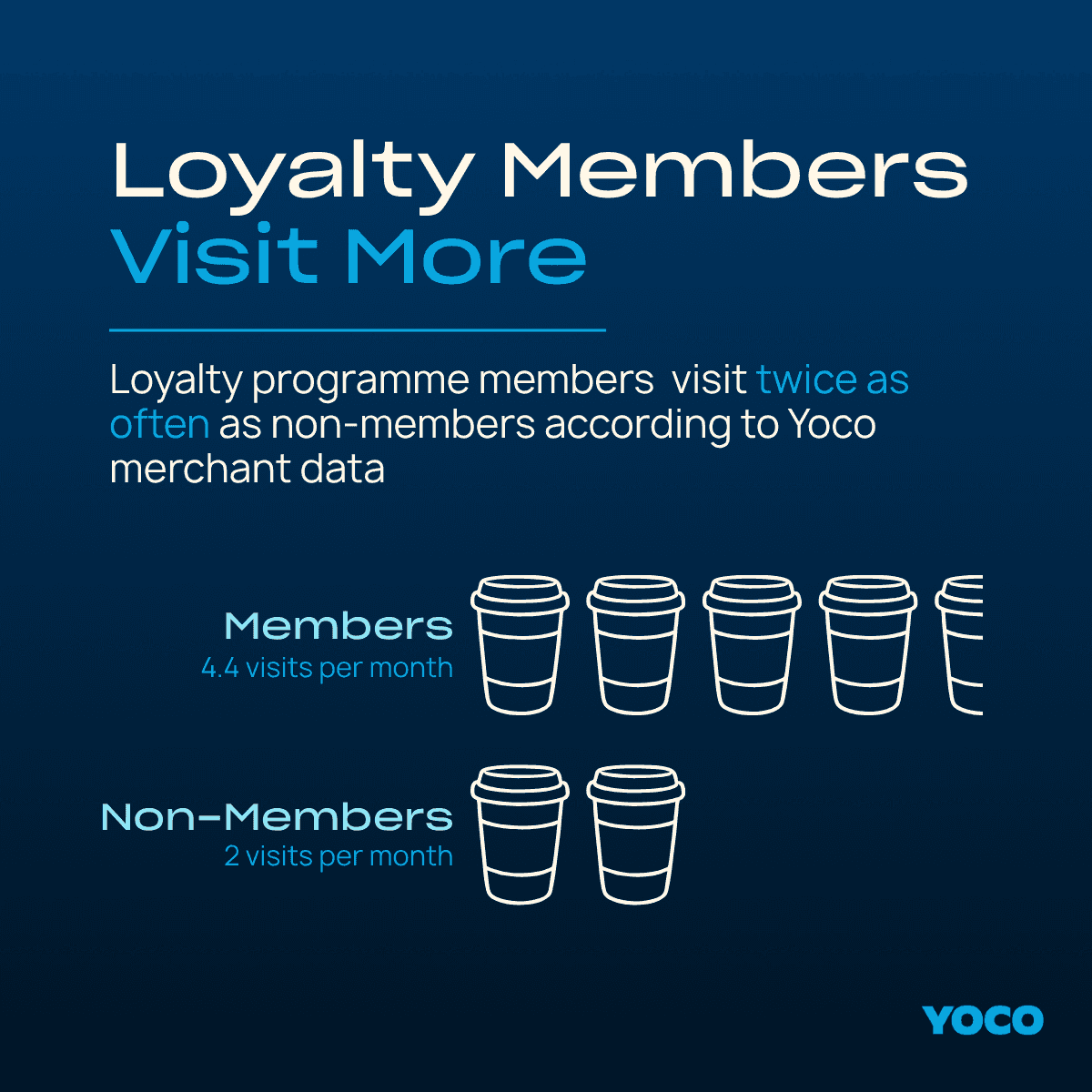
Source: Yoco customer data
What does a good customer loyalty programme actually look like?
Before setting up a loyalty programme, it helps to know what "good" looks like. A loyalty programmes that solves the reward problem while quietly creating a new admin problem isn't a smart one afterall.
An effective programme:
Should be built into what you already use, not bolted on. A separate loyalty device or app means one more thing to charge, insure, and train staff on. The best loyalty setups run on the same machine and system you already use at the till.
Does not ask customers to download anything. A phone number or a tap should be enough to join. Every extra step between "I want to join" and "I'm in" loses you a share of customers who would otherwise have signed up on the spot.
Enables staff to run it in seconds, not minutes. If redeeming a reward takes longer than the payment itself, it becomes a queue problem. Over time, that becomes a reason for staff to quietly stop mentioning it.
Offers the opportunity to reward the whole basket, not one item. Programmes that only reward a single product or category (such as only rewarding coffee orders) miss every other reason a customer chooses to come back.
Doesn't punish anyone for a system change. If you're moving off paper stamp cards or another platform, customers partway through earning a reward shouldn't lose their progress.
What does this look like in practice for an independent business?
Brewsky Coffee is a great example of what a good loyalty programme looks like in practice, because it shows what happens when all five features are actually in place.
Before switching, Brewsky ran loyalty the way most independent coffee shops do: ten stamps, one free coffee, tracked by hand. It worked in the sense that customers kept the card in their wallets, but it told the business nothing: no way to tie a stamp back to an actual customer, a driver collecting cards between sites, and a manual audit against sales reports every week just to keep it honest.
"In general, we didn't know who our best customers were," says Josh Gavronksy, Brewsky's founder.
The switch to a system built into the payment itself, rather than a second app or device, changed that. Brewsky built a loyalty programme of more than 669 customers in a matter of weeks without losing a single customer with an existing stamp card through the process.
Customers who'd already earned eight or more stamps were moved straight over rather than made to start again. At the same time, rewards were widened to the whole basket instead of just the drinks menu.
"We did it because we believe in our people. And if people are coming every day and they're buying 30 coffees a month, you know, they're part of our conversation, part of our story," Josh says.
The admin side changed too: staff redeem a reward in two steps at the till, and Josh estimates the switch has given him back roughly two hours a week that used to go into reconciling stamp cards by hand.
How do you start a loyalty programme for your business?
Starting your own loyalty programme is often simpler than many business owners expect. Across most businesses and industries, it usually boils down to six decisions:
Decide what you're rewarding.
Visits, spend, or a specific product: pick the one that reflects how your customers actually behave rather than what's easiest to track.Choose a system that's already part of your setup.
If your loyalty programme lives inside the payment system you already use, then there's no second device, no second login, and no manual reconciliation at month-end.Set your earn rate and keep it simple.
Most independent businesses overthink this step. A simple, easy-to-explain rate beats a complicated tiered structure that staff can't describe in one sentence.Tell customers before you switch it on.
A short heads-up like a sign at the till, a line from staff, or a message on the card machine screen promotes excitement and makes for a smooth launch.Migrate fairly, then measure your results.
Carry over existing offers and programmes so your regulars aren’t punished for the change in system.Give your new system time before you measure your results.
A new loyalty programme can take time to gain traction. Give it time before judging the results. This also allows you and your team breathing room to iron out any niggles, so you’re getting the clearest idea of its impact.
Loyalty that’s built for independent businesses
The reason most loyalty programmes fail is that they are more work than they are worth. Stamp cards get lost. Apps go unused. And someone has to run the whole thing. In growing independent businesses, this often all falls on the owner.
That is the part Yoco Loyalty takes off the table. With it, points build automatically on every card tap. There is no app for your customers to download and no card for them to lose. They join once with a phone number, linked to the card they already tap. WhatsApp keeps them posted on their points, and they redeem at the counter with the same number.
As Josh from Brewsky puts it: "You put in your cell phone number once, and people can't believe that." For you and your staff, there is nothing extra to run. It is built into the Yoco system you use for payments.
You switch it on, choose how customers earn, and it runs itself.
Frequently asked questions
Is a loyalty programme worth it for an independent business?
Yes, provided it doesn't create more work than it saves. The return comes from keeping regulars rather than constantly replacing them. This matters more for community-based businesses than for their larger counterparts with bigger budgets.
What's the difference between a paper stamp card and a digital loyalty programme?
A stamp card tracks a purchase, not your base. That means there's no way to see how big your pool of regulars is across the entire business. A lost or stolen card can be redeemed by anyone who finds it. A digital programme ties every visit to an actual customer, with no card to lose and no manual reconciling at the end of the month.
Do customers need to download an app to join?
No. The best loyalty setups let a customer join with something they already have on them, like a phone number, rather than asking them to install something for the sake of one discount.
How long does it take to set up a loyalty programme?
For a system that's already integrated into your payment tools, this can realistically be same-day: set an earn rate, tell your staff, tell your customers, and it's live.
Will switching to a new loyalty system lose my existing customers' progress?
It shouldn't. Look for a provider that lets you carry over existing stamps, points, or progress rather than asking loyal customers to start again from zero.
Ready to reward your regulars?
If you're on the Yoco Plus Plan, switch on Yoco Loyalty in the Manage tab. It runs on the machine you already use, on the same account with the same payouts.
New to Loyalty? Follow the step-by-step setup guide in the Yoco app or go to yoco.com to get started.


Need help finding the right product?
Let us help you choose the best fit for your business.