Beyond Growth - Volume 1: How Sheryl Ozinsky grew the Oranjezicht City Farm Market
The cofounder of the Oranjezicht City Farm Market details how they’ve mastered the art of scaling while staying true to its roots.
12 Mar 2026
Yoco Editor
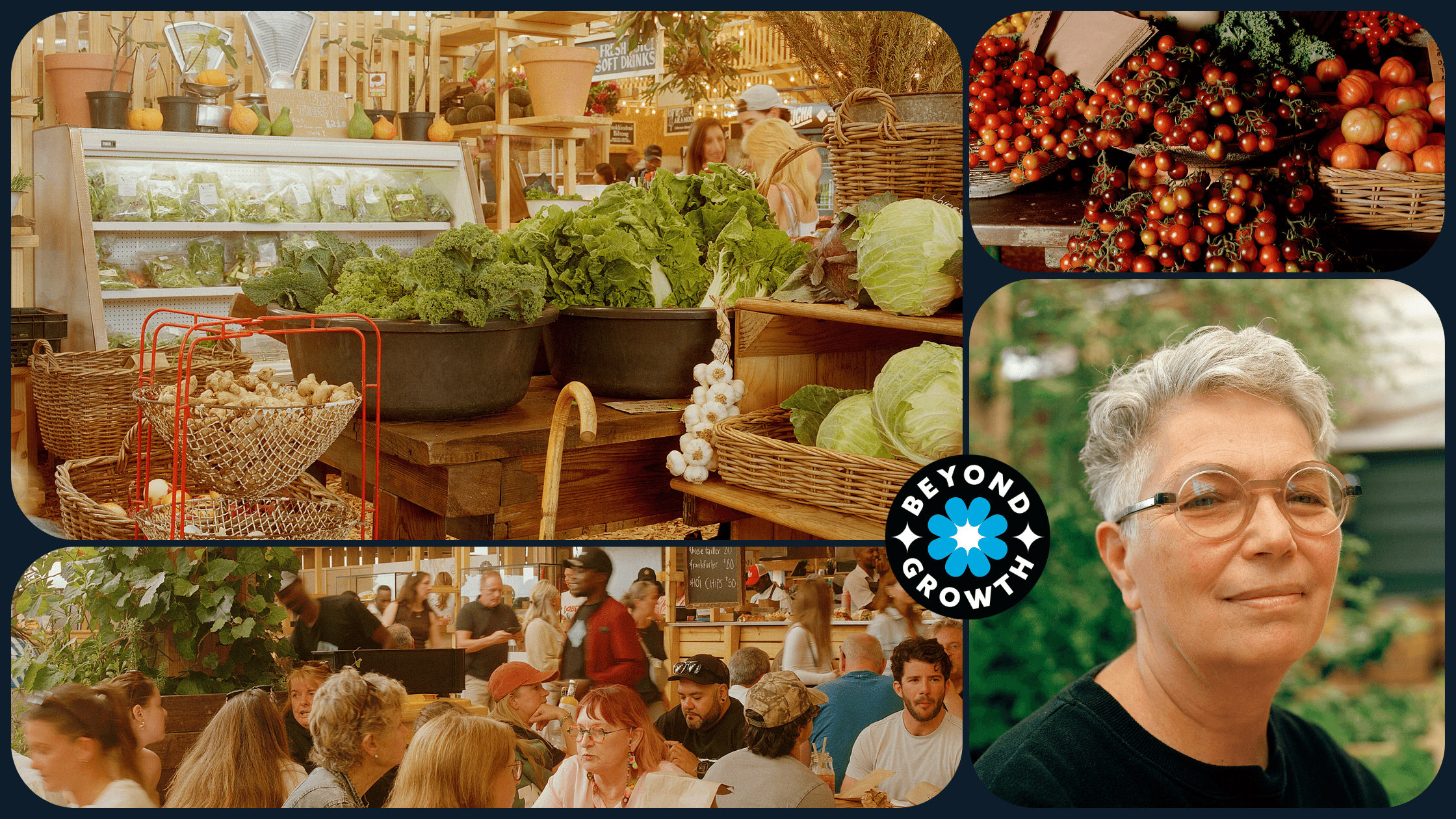
What started as a car boot full of vegetables has grown into the jewel of Cape Town’s food markets. Today, the Oranjezicht City Farm Market at the V&A Waterfront processes tens of millions of Rands annually through Yoco’s range of products, supporting nearly 3,500 livelihoods across farmers, traders, and staff.
Co-founders Sheryl Ozinsky and Caz Friedmann built the market as more than a retail space; it’s a living incubator for food entrepreneurs. By helping independent businesses find their niche, the Oranjezicht City Farm Market has become a crucial engine for long-term, community-supported growth.
We sat down with Sheryl to learn just how they’ve mastered the art of scaling a community market while staying true to its roots.
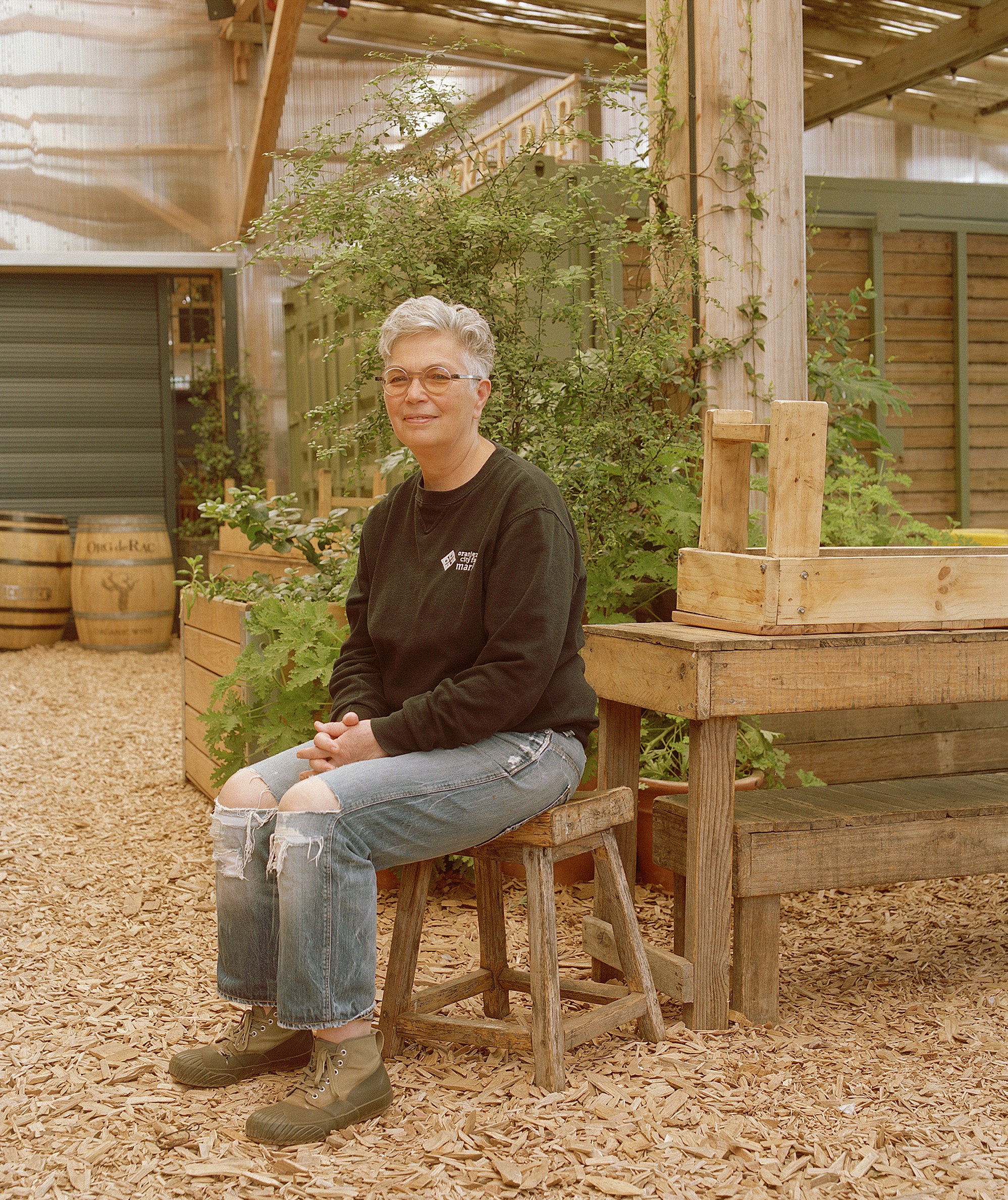
On a Thursday afternoon, founder and co-owner of the Oranjezicht City Farm Market in Cape Town, Sheryl Ozinsky is sitting at a wooden table with a group of teammates tasting preserves, discussing the merits of a marmalade, and deliberating what consistency makes a jam versus a syrup. The team is working on stocking a deli section at the wildly popular weekend and Wednesday night market and has put out an open call for small food businesses and home industries around South Africa to send in their products for selection. Each is tasted and scored by the committee. According to Sheryl, a good market is made with attention to detail, a strong curatorial eye, and world-class products presented beautifully.
Sheryl co-owns the Oranjezicht City Farm Market with her partner Caz Friedmann. Though it’s been held at Granger Bay in the V&A Waterfront precinct since 2015, it began in the neighbourhood of its name, as an offshoot of the Oranjezicht City Farm. The farm and market were established as a shared gathering place for their immediate community, which grew wider as they moved across town to the Waterfront.
In December 2025 the market moved from the bustling stretch of tents in Granger Bay needing structural-approval every two weeks to their current state-of-the-art, purpose-built permanent fixture built by the V&A Waterfront. Their dedicated team of 25 people worked around the clock preparing to welcome thousands of visitors every weekend. At the last count of team members, suppliers, traders and their employees, an estimated three and a half thousand people are supported by the market. That’s not to mention all of their traders’ suppliers. After a busy month over the festive season, Sheryl saw a comment on social media calling the new market a ‘tourist trap’. “People spew out stuff and they don't really understand what is behind this, how hard we work here, how many mouths we feed here, how many livelihoods exist here,” she says. “The market is something that South Africans should be so proud of.”
Supporting local organic farmers is the mission at the heart of the market. When they first started, they put out a call for produce, but most farmers couldn’t spare the time, travel, or staff to stand at a market all day with no guarantee of sales. So instead the Oranjezicht City Farm Market took on the risk themselves and purchased produce directly from the farmers, which they still do today. The produce section began with only what Sheryl could fit into her car while collecting from the farms, they now work with 35 - 40 farms in the Western Cape, the furthest being a tomato grower in Sedgefield. They source, select and display the most beautiful, flavourful and seasonal fruit and vegetables, often of more interesting varieties than can be found in supermarkets. Their suppliers are very often small-scale, family-run farms like Valota farm in Philippi, Sababa farm in Piket-bo-berg, or Botanical Taste in Tulbagh. A programme started to teach school children how to grow food now supplies their brinjals.
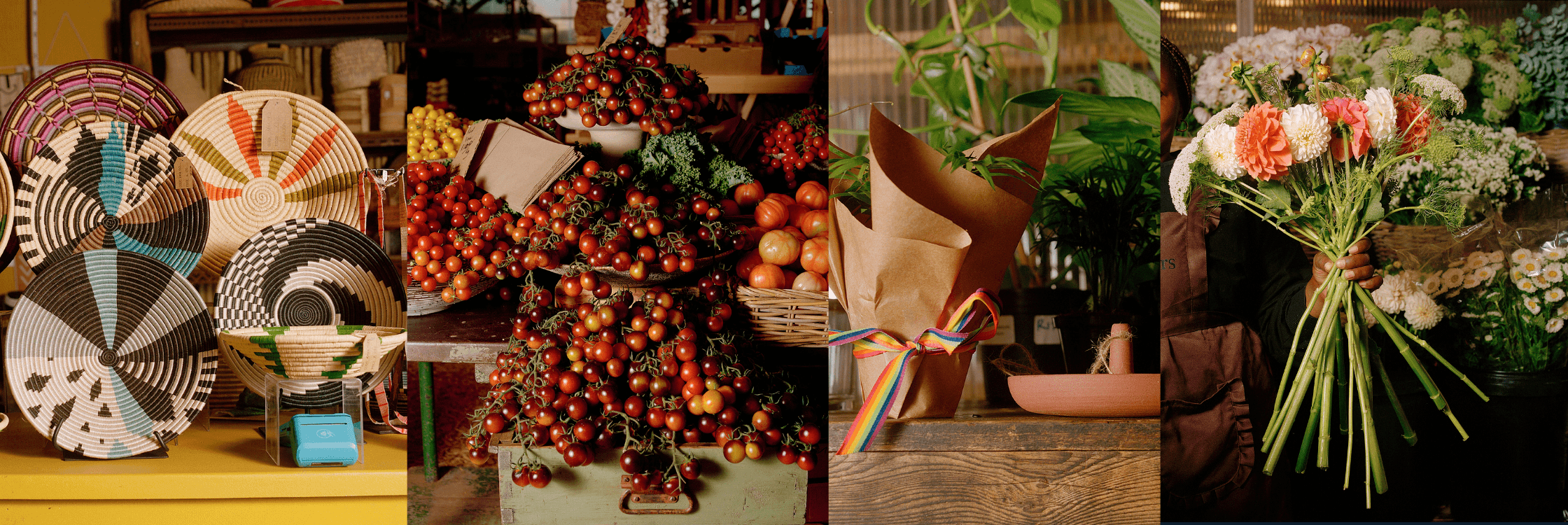
The bountiful display of the curated fruit and veg is a photogenic feast that is naturally shared all over social media. “To be honest, we haven't got a marketing budget,” Sheryl says. “We don't need to do much because people do it for us. And we are very happy and lucky that way.” Creating an experience that inspires visitors to authentically spread the word is both a saving and an invaluable endorsement.
There’s a story of an entrepreneur behind each cup of coffee, punnet of blueberries, or hunk of cheese at the market, and it’s a hunger for these stories that Sheryl believes is stoking the growth of markets in a system where supermarkets dominate the landscape, and dictate what’s grown on the land. “I think the renaissance of the market is coming from the fact that people are tired of the supermarket; big brand names, big chains that present themselves in exactly the same way no matter where they are,” she says. “[At markets] you can go and find out what the neighbourhood auntie is making and how she's making her jam in the same way that her mother and her grandmother did. Those stories have been passed down from generation to generation, and I think that appeals to people because they’re conscious of the story, their own personal health, and they like to be informed about a product.”
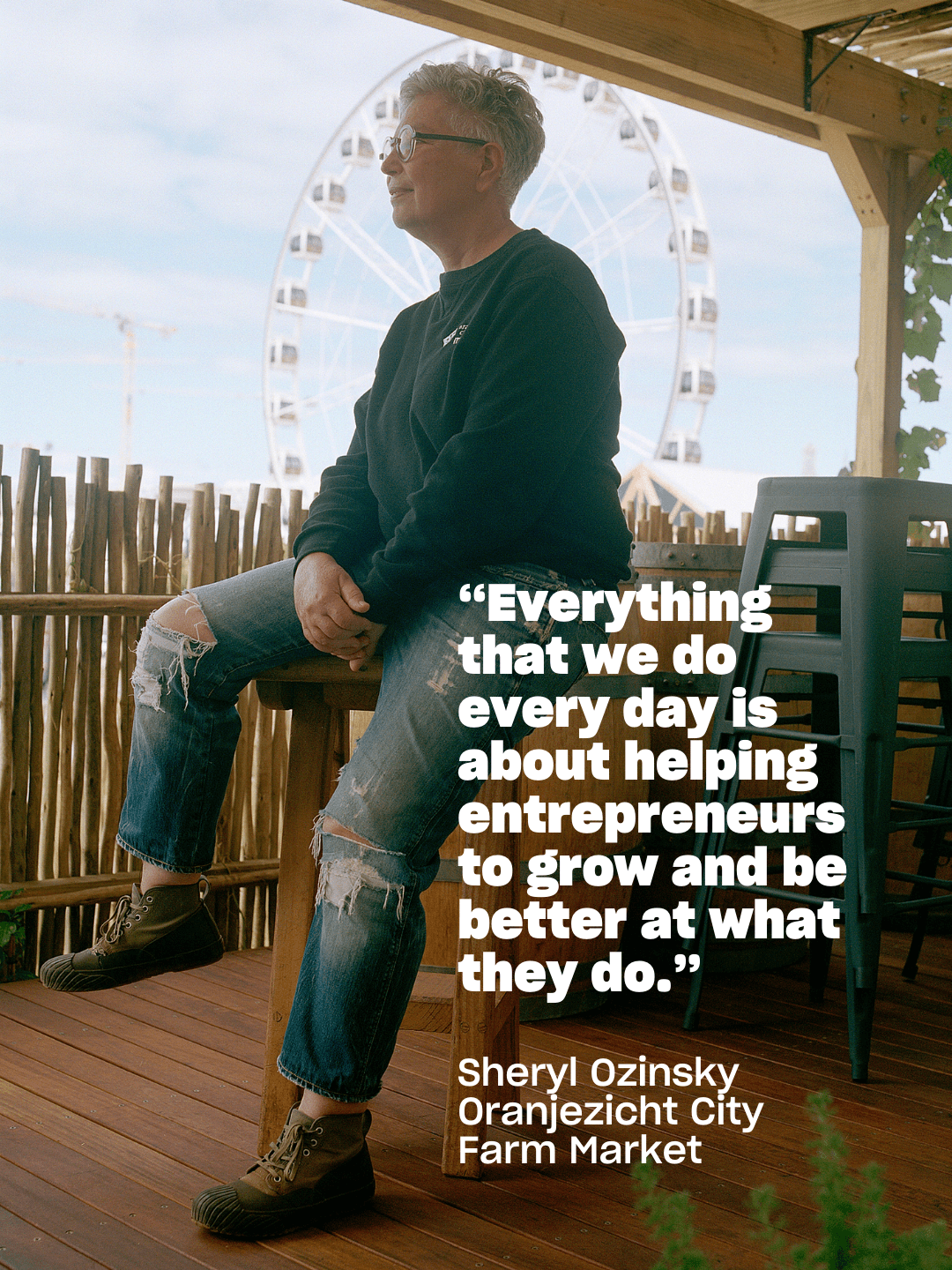
Sheryl can tell you the backstory of every vendor at the market. “Every story tells of passion, absolute dedication and incredible resilience, through COVID, droughts and electricity crises.” The space has become an incubator for entrepreneurs, many who have started selling their homemade products from the top of a wine barrel before growing into a fully-fledged stand. The barrier to starting out is low. “They don't have to have a massive kitchen where they work. They don't have to have 20,000 staff and they don't have to supply 2,000 stores around South Africa. They can bring 20 bottles and that's enough,” Sheryl says. With immediate exposure to thousands of visitors, a vendor can rapidly test whether a product is going to sell. “Everything that we do every day is about helping entrepreneurs to grow and be better at what they do. There's a huge amount of support for a small business operator here that they wouldn't necessarily be able to do on their own.” Of course the responsibility of running your own premises is taken care of for vendors, but smaller support helps to ease the burden too. For example, a coffee barista can rely on the team on the ground to receive their milk order pre-market day and make sure it’s refrigerated, and team members are on hand to help vendors offload their vehicles.
The Oranjezicht City Farm and Market began as a volunteer-based, non-profit project, but as it grew, Sheryl soon realised it wouldn’t survive that way. “One couldn't expect people to work this hard for absolutely nothing,” she says. “So in order to make this work, we had to convert it into a business.” The market was split from the farm becoming the PTY Limited that Sheryl and Caz own and run, and the farm became a trust that can apply for funding. They pay the farm a monthly fee in order to retain the name. “This should be a non-profit because we exist to support farmers and consumers,” Sheryl says. “But in South Africa, there is no funding that would be available to a project like this.” She’s noticed that there’s also little understanding of a market as a business in South Africa. She notes that while she’s been interviewed for lifestyle or agriculture platforms, she’s never once been interviewed by a business programme. “And yet this market is performing like a business in every way.” The biggest trader at the market is the market itself, directly running several of the stores like the fresh fruit and vegetables, the deli, and the bars, and always exploring new business avenues.
The move to the new premises at the V&A Waterfront, though just across the road, was a bold leap for the business. As construction progressed, Sheryl and Caz were looking for an investor to help them secure the deal in motion. “There was no one local that wanted to back this project. We had to go offshore to find an investor, which in itself says something about how small businesses are supported,” Sheryl says. “And we had the resources, we knew people and it still took us two years and a lot of stress to get through that period. We almost didn't make it. We almost closed it down.” But the right person saw in them exactly what Sheryl so admires in the entrepreneurs represented at the market: “the passion of the people that run the place. Entrepreneurs are unique animals. They're not like anybody else. They live, eat, sleep, breathe what they're doing.”
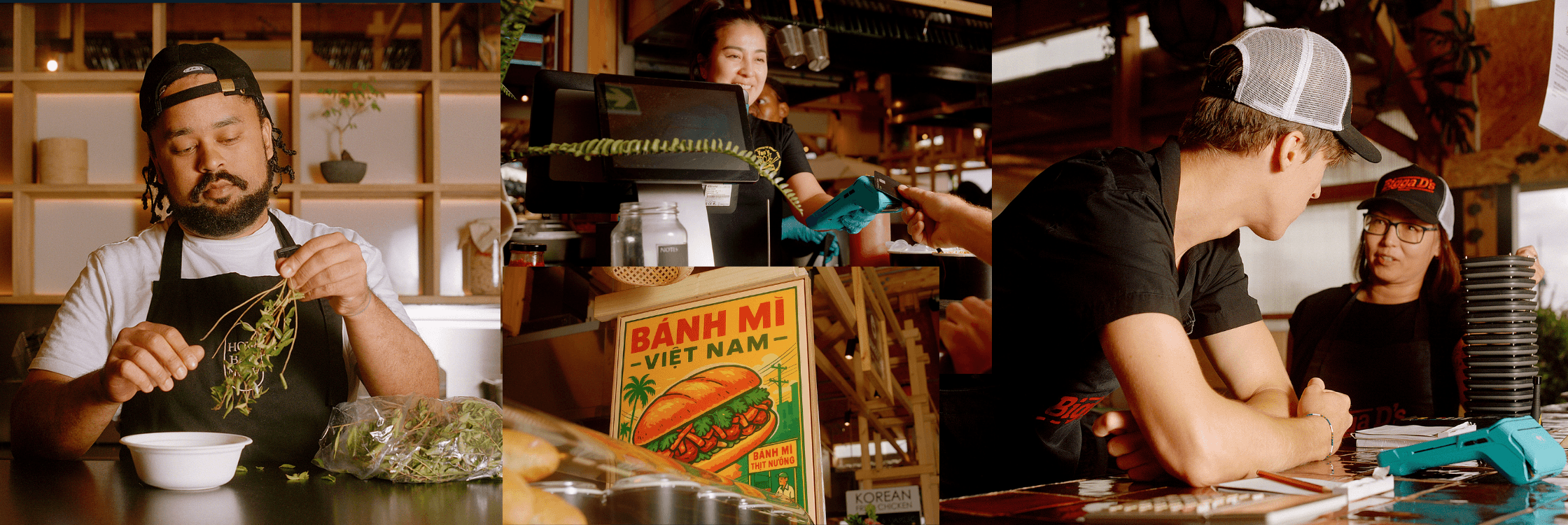
People have asked for the Oranjezicht City Farm Market concept to be brought to Johannesburg, San Diego, and Sydney. But what the team is invested in is teaching and supporting farmers to run markets within their own communities and context. “As you get older, you realise you don't need more for yourself,” Sheryl says. “You need more of what you can do for other people.” Sheryl and Caz’s founder story runs concurrently with so many others: a brick and mortar Vietnamese restaurant that started with a Bánh mì sandwich stand, a bakery that opened off the back of selling cinnamon buns on weekends. “At the end of the day I think [the Oranjezicht City Farm Market] is a place that people come to because they do want that story. They do want to see what's unique about this town. It's Cape Town by Cape Town. What an honour to represent a city like this. Actually, what an incredible honour that we get to work here. That we get to do this every single day.”
Stories like Sheryl’s show what growth can look like when it’s rooted in community. What started with a car boot full of vegetables has grown into a thriving ecosystem of farmers, traders, and entrepreneurs, proof that independent businesses don’t just grow, they multiply their impact.
But this isn’t just one story. Across South Africa, thousands of independent businesses are building livelihoods in ways that look a lot like the Oranjezicht City Farm Market: locally rooted, resilient, and powered by people who care deeply about what they do.
In our accompanying data analysis, we zoom out to see the bigger picture, using Yoco transaction data to explore the broader patterns behind how independent businesses are growing today.
Because beyond the numbers, it’s stories like Sheryl’s that show what growth really means.
Let’s grow.
Need help finding the right product?
Let us help you choose the best fit for your business.